Thai Massage vs Deep Tissue Massage: Which One Do You Need?
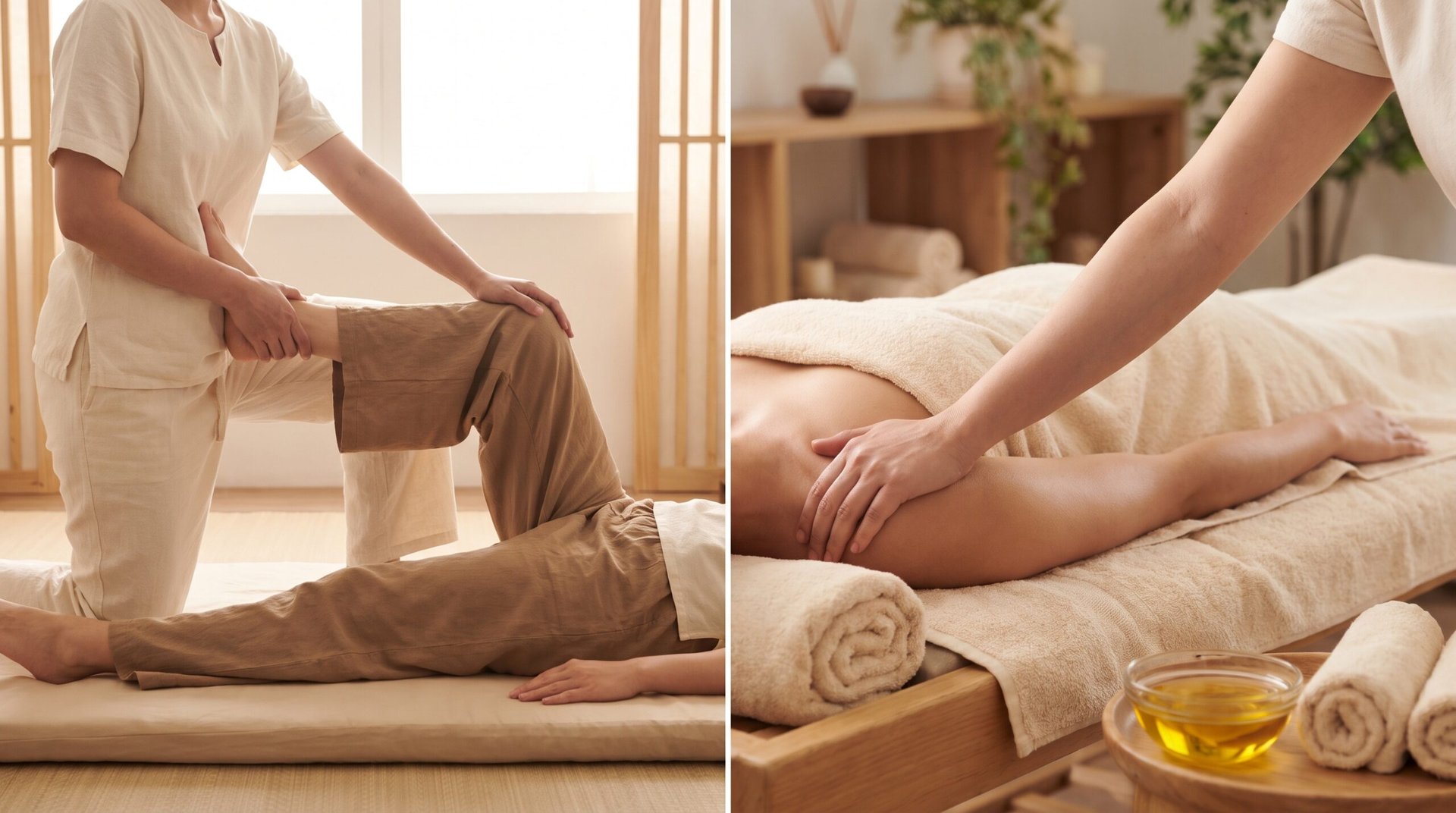
The short answer: Thai massage moves you. A therapist compresses, presses and stretches your body, usually on a mat, in loose clothing and without oil. Deep tissue massage holds you still: slow, firm pressure with oil, aimed at tight spots. If you feel stiff all over, try Thai. If one area keeps nagging, try deep tissue.
The honest answer to "Thai or deep tissue?" is that it's the wrong question. The better one is what you want to feel when you stand up. This page explains how Thai massage vs deep tissue massage differ in practice, what research exists (less than you'd think), who should be careful, and how to ask for what you want.
Thai massage vs deep tissue massage: side by side
| Thai traditional massage | Deep tissue massage | |
|---|---|---|
| Main technique | Compression, rhythmic pressure, assisted stretching and gentle rocking | Slow, firm pressure and targeted work on tense areas, including trigger points |
| Your position | Mat or low bed; you are guided into stretches | Massage table; you lie still |
| Clothing | Loose, comfortable clothing | Undressed to your comfort level and covered with towels |
| Oil | Usually none | Usually yes |
| Tools | Hands, thumbs, forearms, elbows, knees and feet | Mostly hands, thumbs, forearms and elbows |
| Pace | Rhythmic and flowing between positions | Slow and deliberate |
| Coverage | Usually the whole body in one session | Often focused on problem areas such as back, neck, shoulders, legs |
| Feels like | Active, like gentle assisted yoga | Firm and focused, can be intense on tight spots |
| Best for | Stiffness, feeling tight all over, people who like movement | Specific tight spots, desk and travel tension |
| At our studio (60 min) | €60 | €50 to €65, see the services page |
Technique and tool descriptions follow the National University of Health Sciences' overview of Thai massage and the deep tissue pilot study listed in the sources. How a session goes always depends on the therapist and on you.
Pressure is not the real difference
A common belief is that deep tissue is "strong" and Thai massage is "soft". That doesn't match what happens in a room. Thai massage can be firm, especially on legs and backs, because the therapist can lean body weight through hands, forearms and feet. Deep tissue can be gentle if you ask for it. What actually separates them is how the work is done:
- Thai: pressure plus movement. The therapist guides your limbs into stretches and works the whole body in a rhythm.
- Deep tissue: pressure plus patience. Slow strokes and held pressure on areas that feel tight, with you completely passive.
- Thai oil massage sits in between: oil and flowing strokes, usually the gentlest of the three.
Thai massage vs deep tissue massage: which should you choose?
Choose Thai traditional if you...
- Feel stiff or tight all over, not in one spot
- Like stretching, yoga or moving your body
- Don't want oil on your skin
- Want a session that covers legs, back, arms and shoulders in one go
- Have spent a day walking and want your legs loosened up
Choose deep tissue if you...
- Have one or two tight spots, such as shoulders, neck or lower back
- Spend long hours at a desk, on a plane or driving
- Prefer to lie still and let the therapist do the work
- Are comfortable with firm, concentrated pressure
- Want to spend most of the session on a few areas
Not sure? Book a 60-minute Thai oil massage (€50) or Thai traditional (€60) for a first visit, and tell your therapist where you hold tension. If you want firmer, more focused work next time, book deep tissue. Prices for every treatment are on our services page.
Thai massage vs deep tissue massage: what the research says (and doesn't)
Both styles are popular, so you might expect plenty of head-to-head studies. We went looking in October 2026 and didn't find a single trial that compares Thai massage with deep tissue massage directly. What exists is smaller and more scattered:
| Source | What it looked at | What it shows | Limits |
|---|---|---|---|
| Keeratitanont et al., 2015 (review) | Six controlled trials of traditional Thai massage for chronic pain | The authors concluded the findings support Thai massage for reducing pain severity | Only six studies; the authors call for more research |
| Furlan et al., 2009 (Cochrane Back Review Group) | 13 trials of massage in general for low back pain | Massage might help subacute and chronic non-specific low back pain, especially combined with exercise and education | Not specific to Thai or deep tissue; 8 of 13 trials had high risk of bias |
| Deep tissue pilot study (PMC5563410) | 27 men with ankylosing spondylitis; 10 sessions of 30 minutes over 2 weeks | Deep tissue work reduced lower back pain more than a relaxation-style massage, by about 20 mm on a 100 mm scale | Small pilot study; no group without massage; one condition only |
| Direct comparison of Thai vs deep tissue | Head-to-head trial | We searched and did not find one | So no one can honestly say one beats the other |
So what can you take from this? Massage in general may help some people with long-lasting low back pain, there is some supportive research for Thai massage and chronic pain, and there is early, small-scale evidence for deep tissue work on back pain. None of this proves one style is better. Be cautious about any website, including ours, that says otherwise.
Claims we'd ignore
- "Releases toxins" or "detoxes" the body. We haven't seen good evidence for this, and we've left that language out of this page.
- That one style "cures" back pain, sciatica or any medical condition.
- Energy-line explanations (Sen lines) as proof of a medical effect. They are a traditional framework, and you don't need to believe in them to enjoy the massage.
Who should check with a doctor first?
Both styles use firm pressure, and Thai massage adds stretching. Speak to your doctor first, and tell your therapist when you book, if any of these apply:
- You are pregnant (we offer a pregnancy massage; deep tissue is generally avoided in early pregnancy)
- You have osteoporosis
- You take blood-thinning medication or have a bleeding or clotting disorder
- You have a recent injury, fracture or surgery
- You have an acute illness or fever
- You have skin problems, open wounds or infections in the area being treated
These cautions are commonly listed by massage providers and health sites. This page is general information, not medical advice.
How to ask for the right pressure
Most "bad massage" stories are communication problems. A few lines that work:
Say what you want before you lie down
Tell the therapist the areas that hurt, any injuries, and whether you want gentle, medium or firm.
Speak up during the session
You can ask for softer or firmer pressure at any time. A good therapist expects it.
Notice sharp pain, numbness or tingling
Say so immediately. Intense pressure on a tight muscle is one thing; sharp or electric pain is another.
Afterwards, drink water and take it easy
Give yourself a gentle evening. Some people feel a little tender after firm work. If it's more than that, or lasts, speak to your doctor.
Thai and deep tissue massage in Lisbon
At Thai Gold Massage we offer both, plus Thai oil, hot stone, aromatherapy, foot, pregnancy and four-hand massage. We're near Rossio and Praça dos Restauradores, open every day from 10:00 to 20:00, and walk-ins are welcome.
| Treatment | 60 minutes | 90 minutes |
|---|---|---|
| Thai traditional massage | €60 | €75 to €90 depending on treatment |
| Thai oil massage | €50 | €75 to €90 depending on treatment |
| Deep tissue massage | €50 to €65, see services page | €75 to €90 depending on treatment |
Read more: What is Thai massage? · Thai massage benefits · What to expect in your first session · Massage near Rossio.
A transparent note: we run Thai Gold Massage, so we benefit if you book with us. We've tried to describe both styles fairly and to say where the evidence is thin. Massage is not a medical treatment. If you have persistent pain, see a doctor or physiotherapist.
Frequently asked questions
What is the main difference between Thai massage and deep tissue massage?
Thai massage uses compression, rhythmic pressure and assisted stretching, usually on a mat or low bed, in loose clothing and usually without oil. Deep tissue massage uses slow, firm pressure aimed at deeper muscle layers and tense spots, usually with oil, with you undressed and covered by towels. In Thai massage you are moved into stretches; in deep tissue you lie still.
Is Thai massage deeper than deep tissue massage?
Not by definition. Deep tissue is defined by slow, concentrated pressure on tight areas. Thai massage can feel firm, but its main tools are compression and stretching across the whole body. How strong either one feels depends on the therapist and on the pressure you ask for.
Thai massage vs deep tissue massage: which is better for back pain?
We couldn't find a trial that compares the two directly. A 2015 review of six controlled trials supported Thai massage for reducing chronic pain, and a small pilot study found deep tissue work reduced lower back pain more than a relaxation massage in men with ankylosing spondylitis. Both bodies of research are small, so choose the style you will actually enjoy and talk to your doctor about persistent pain.
Does Thai massage hurt more than deep tissue?
Neither should be painful. Both can feel intense on tight spots. If the pressure is too strong, tell your therapist right away and they will adjust. Pain you have to grit your teeth through is not a sign it is working.
Which is better for stress and relaxation?
Many people find Thai oil massage the most relaxing, because it is slow and gentle. Thai traditional can feel relaxing too, but it is more active. Deep tissue is firmer and more focused, so it suits people who want to work on specific tight spots more than switch off.
Can I get Thai massage and deep tissue massage in the same visit?
Ask the studio before you book, because it depends on the length of the session and the day's availability. Whatever you choose, tell your therapist which areas need attention.
Which massage is best for sore legs after walking all day?
Many visitors pick Thai traditional massage for the stretching, or deep tissue if their calves and shoulders feel tight. A foot massage is a shorter option. Tell your therapist where you feel it.
Who should check with a doctor before deep tissue or Thai massage?
Speak to your doctor first if you are pregnant, have osteoporosis, take blood-thinning medication or have a bleeding or clotting disorder, have a recent injury or surgery, an acute illness or fever, or skin problems in the area to be treated. Tell your therapist about any of these when you book.
Ready to book?
Tell us what you want to feel afterwards and we'll suggest a treatment. Open every day, 10:00 to 20:00.
Sources
- Keeratitanont K, Jensen MP, Chatchawan U, Auvichayapat P. The efficacy of traditional Thai massage for the treatment of chronic pain: a systematic review. Complementary Therapies in Clinical Practice, 2015;21(1):26-32. PubMed
- Furlan AD, Imamura M, Dryden T, Irvin E. Massage for low back pain: an updated systematic review within the framework of the Cochrane Back Review Group. Spine, 2009;34(16). PubMed
- Comparison of Deep Tissue Massage and Therapeutic Massage for Lower Back Pain, Disease Activity, and Functional Capacity of Ankylosing Spondylitis Patients: A Randomized Clinical Pilot Study (PubMed Central)
- National University of Health Sciences: Thai Massage
- Soothe: Who should not get a deep tissue massage (commonly listed cautions)